Power of networking for startup founders
Ask 10 founders what matters most and you will hear product, fundraising, sales, maybe hiring. Very few will say the quiet word that keeps showing up behind every big break they ever had.
Relationships.
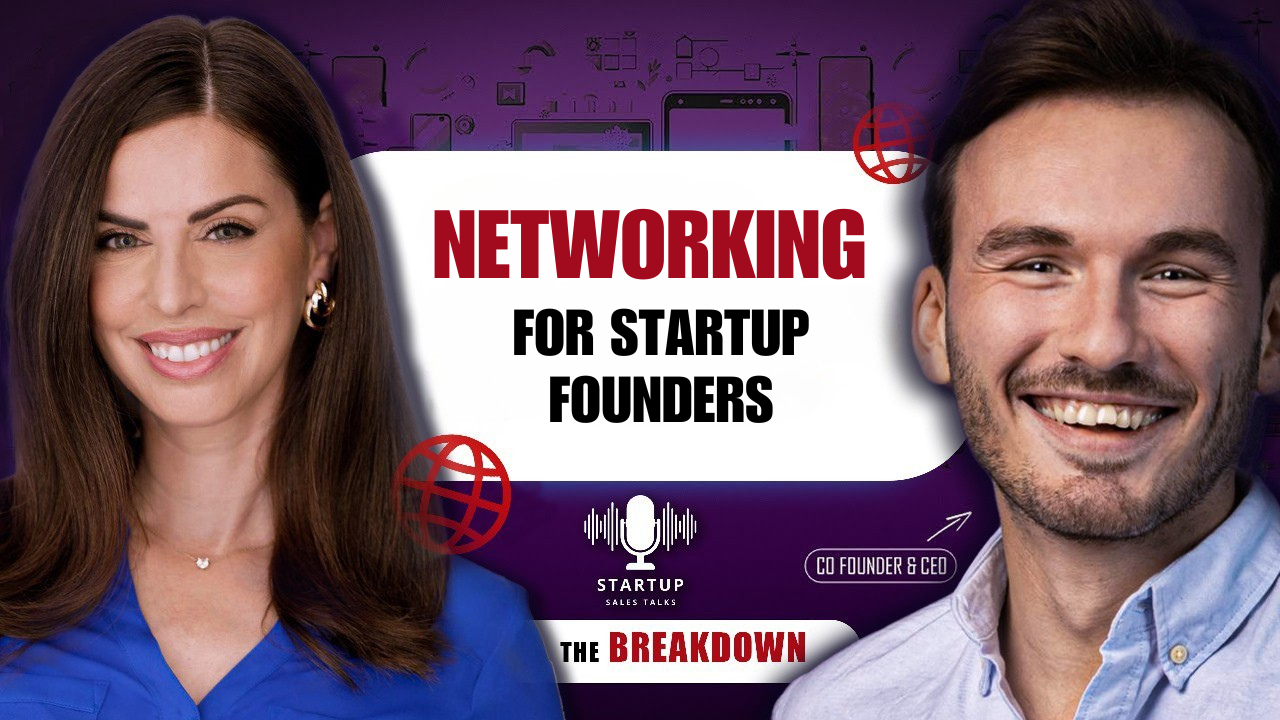
In this episode of Startup Sales Talks, business development and networking expert Lirone Glikman breaks down how founders can turn relationships into a real growth engine, without feeling fake or spammy. She works with brands like Microsoft and Google, with accelerators like Techstars and the Meta accelerator, and she has just published her new book The Super Connectors Playbook.
This conversation is basically a masterclass on how to build a network that becomes your safety net and your unfair advantage.
From small village to global super connector
Lirone grew up in a village of about eight thousand people with dreams that were a lot bigger than her surroundings.
She wanted to work for NASA. She wanted to work on cruise ships. She wanted a global life. Her father was a commercial pilot, so she saw the world early and also saw something painful. She felt small and disconnected from the places and people who seemed to move things.
She noticed a gap.
Between what she wanted and any realistic idea of how to get there.
She also realised something else. She was friendly, but she was not the one who heard news first, who got invited into the right rooms, who knew the right people at the right time. So she started to study what others somehow did naturally.
How do people actually build relationships that lead to information, opportunities and support
Over years she read every classic book, listened to every guru on networking and business relationships, and then tested what worked in the real world.
That led to a few turning points.
- She moved alone to Sydney, knowing three people, and within one month she had her own radio show in a new language.
- Within 2 months she landed a job in the head office of one of the biggest corporations in Australia in their marketing team despite not being local and not having the usual university background.
- Later she moved to New York and challenged herself. This time she applied her own method very deliberately. Within three weeks she had a job in a tech focused PR firm, again without the classic resume that usually opens those doors.
Those experiences were the proof that her approach to relationships worked across cultures and continents. Eventually she turned it into her firm The Human Factor and into a structured method she now teaches to startups around the world.
The six phase system for building business relationships
Lirone describes her method as both strategic and deeply human.
It has 6 phases.
The first 3 are about strategy.
The last 3 are about communication and behaviour.
Phase one know your goals
Most founders carry vague goals in their head.
- Raise money
- Get more customers
- Grow in a new market
Lirone forces them to get specific. You can have multiple goals at once, for example closing a three million round in the next year and also hiring a full stack engineer this quarter. Each goal demands a different set of people.
If you do not know exactly what you want, your networking becomes random. The first phase is simply clarity.
Phase two people strategy
Once the goals are clear you shift your thinking.
Instead of asking what should I do you start asking who do I need.
For each goal you map the types of people who could help investors, clients, connectors, mentors, talent and then check which ones you already know and which ones you still need to meet.
This is a mental habit as much as a tactic.
Lirone calls it training your mind to always see the people connected to any goal. If you keep that lens long enough your network slowly becomes a very practical asset instead of a nice vague thing you mention on your slide deck.
Phase three personal brand
At some point you will reach out.
If your presence online and on paper is weak or confusing many doors will close before they even open.
Personal brand is not about pretending. It is about choosing which parts of your real story you highlight so the other side understands why you are someone worth talking to.
Investors need to see traction and clarity.
Corporate partners need to see reliability and fit.
Potential hires need to see that you and your company are not chaos in a hoodie.
If you do not decide how you want to be perceived, Google and now large language models will decide for you. And they do not care about your goals.
The human part breaking the ice maintaining and leveraging
Once you know what you want, who you need and how you want to show up, you move to the interpersonal half of the system.
Phase four communication and first contact
How do you break the ice without being weird
How do you move beyond small talk while still using small talk
Lirone leans on a simple sequence from the marketing world.
- Know.
- Like.
- Trust.
- Buy.
First people need to know you exist. Then they need to feel some level of liking or positive emotion towards you. Then they need to trust you. Only then will they be willing to buy from you, invest in you, or open their network for you.
On LinkedIn this can look like
- A thoughtful connection request mentioning a genuine reason.
- A real comment or reaction to their content that shows you actually read it.
- A short message referencing something you have in common or something specific you appreciated.
At live events it looks like curiosity instead of pitch mode. You ask about their journey, their role, their current priorities. You make it about them first. Only later does it become a conversation about your product.
Phase five maintaining relationships the ninety list
This is where most founders fail.
They meet people, collect business cards, connect on LinkedIn, then disappear into delivery mode for six months.
Lirone uses an idea from marketer Michael Port called the ninety list.
You write down up to 90 people who are important for your short term and long term goals.
Some you already know well.
Some you barely know.
Some you have not met yet.
This list can include potential clients in a target market, warm investor leads, mentors, future hires, journalists. The key is that all of them are genuinely relevant.
Then you give this list 10 focused minutes every workday.
You pick one to three people and do something tiny that keeps the connection alive.
- A comment or reaction on something they posted.
- A short message with a relevant article.
- An introduction that could help them.
- A simple check in or holiday wish that does not ask for anything.
If you cycle through ninety people this way you touch each person at least once a month in a non annoying way.
Over time those small touches create familiarity and trust. When the right moment comes asking for a meeting or proposing a collaboration no longer feels abrupt.
It simply feels like the next step in a relationship that already exists.
Phase six leverage and asking
If you build relationships well, asking for help or for a deal becomes the easy part.
Lirone is very direct here.
Opportunities rarely fall in your lap. You have to ask.
She even jokes about squeezing the lemon with a smile. When someone has already said yes to one thing there is often room to ask for the logical next step while the energy is still there.
The key is that the request comes after real value and real connection, not instead of it.
Authentic networking without feeling fake
Many founders dislike the word networking because it feels transactional.
They do not want to be the person who only shows up when they need something.
Lirone agrees with the aversion to fakeness but challenges the conclusion.
If you avoid reaching out you will simply get less in life.
Her answer is simple.
Authentic and strategic at the same time.
You can admit your goals to yourself and still start every relationship with genuine interest in the other person.
One of her favourite examples is a startup she worked with in the web three world. Their dream investor was Gary Vaynerchuk.
They did not spam his inbox.
They bought an expensive ticket to a small private bowling event where he would actually be present as a human. Months before the event the founder took bowling classes, purely to increase his chance of beating him and catching attention in a playful way.
They studied Garys early story, his family background, his values and prepared a few personal questions that would create emotional connection rather than startup pitching.
At the event they focused on the human interaction. Bowling, talking about family and holidays, finding real common ground.
The pitch came later.
The result was a string of calls and meetings and eventually a real investment.
Not because they tricked anyone.
Because they treated him like a person and did their homework.
Handling social anxiety as a founder
Here is the part nobody talks about on LinkedIn.
Most people are nervous in social situations.
Lirone shares a striking statistic from research.
Around 90% of people have some form of social anxiety.
Sometimes it is one on one.
Sometimes it is speaking to authority.
Sometimes it is events with many people.
That means your fear is not special. Everyone at that conference is slightly uneasy, including the investor and the enterprise buyer.
Knowing that alone can lower the pressure.
Lirone suggests a few practical ways to manage that fear.
- Anchor yourself in your bigger goal. Your dream for the company needs to be louder than the discomfort in your stomach.
- Understand your biology. After a few seconds of conversation and a couple of smiles, your body releases oxytocin, the trust and bonding hormone. The first seconds feel awful. Then your chemistry starts helping you.
- Prepare short pitches for the main types of people you will meet investor, client, mentor, partner. When you know your first two sentences by heart, you can focus on listening rather than panicking.
- Use a wingperson. Going to a big event with a cofounder or colleague makes it easier to open conversations and less intimidating to stand at a booth or approach someone.
Most importantly, she reframes the feeling itself.
Instead of telling yourself I am scared, tell yourself I am excited. This energy means you care and that something meaningful might happen.
Personal branding in a world flooded with AI content
One of the more surprising parts of the conversation is a simple statistic.
Around 90% of posts on LinkedIn are now AI generated.
That means two2things.
Your audience is swimming in generic content.
And authenticity just became a serious competitive advantage.
Lirone gives a few simple ways for founders to show up as credible and real on LinkedIn without becoming full time influencers.
- Share short case studies or stories from your own world and add your point of view.
- Share an article from a serious publication and write a few lines of your commentary. You attach your brand to respected brands and show you are plugged into your field.
- After events, write a practical summary with three or four insights. You show that you attend serious rooms and that you think about what you learn.
- Use your profile to spotlight others. Podcast guests, customers, team members, partners. Tag them, thank them, highlight their achievements. Being the person who amplifies others is a strong brand in itself.
- Post at least once a week with intention. You can absolutely use AI to help you draft, but always inject your own voice and edit until it sounds like you, not like a template.
- Video is an easy shortcut here. It is harder to fake, easier to connect with and carries your tone, facial expressions and energy in a way text never will.
Using AI without losing the human factor
Lirone is not anti AI. She uses it herself.
She just insists on keeping the human in the loop.
For founders and sales teams AI is great for
- Researching companies, markets and people.
- Drafting outreach ideas or suggested messages.
- Summarising notes from calls and events.
- Turning raw data into more readable reports and content.
She even suggests literally asking an AI model how would you approach this person given my goal and our previous conversation Then taking that suggestion and editing it heavily until it feels right.
The danger is not the tool. The danger is outsourcing your judgement and your voice.
The future belongs to people who combine both superpowers.
Machines for speed and structure.
Humans for nuance, ethics and emotional connection.
Creative icebreakers at trade shows and events
Not all networking needs to feel formal.
Dom shares a story from a trade show where a Dutch booth did something extremely simple.
They did not ask passers by if they wanted a demo.
They did not jump into a pitch.
They simply asked
Do you want a candy?
That tiny question lowered every barrier. People stopped, smiled, took the candy and then naturally moved into conversation.
Lirone connects this to Robert Cialdinis famous work on influence, especially the principle of reciprocity.
When someone gives you something, even a small gift, you feel an unconscious desire to give something back. In a restaurant experiment, tables that received a small candy with their bill gave significantly higher tips. When the waiter gave a candy, walked away, then came back and added one more because I like you the tips jumped even more.
The lesson for founders
Little acts of generosity make people more open. The key is sincerity.
Do not bribe people. Delight them.
Give first ask second the mindset shift founders need
Many early stage founders walk around with a silent script in their heads.
I am small.
I have no budget.
I need help.
They approach investors, corporate leaders and mentors from a place of lack.
Lirone flips this completely.
Even as a small startup you have a lot to give.
Access to fresh data.
Knowledge of a niche industry or technology.
Connections to other startups.
Eyes and ears on a specific market.
Energy and creativity that big organisations often lack.
She has seen over and over that relationships with brands and investors grew not because founders begged hard enough but because they genuinely helped the other side first. Sometimes by providing useful insight. Sometimes by introducing talent. Sometimes just by being proactive when the other person needed something.
When people experience you as a giver, not just a taker, they are far more willing to open doors for you when you finally make an ask.
Relationships as your real safety net
The heart of Lirone Glikmans message is simple.
If you build relationships with intention and authenticity you eventually create your own safety net.
A network you can lean on for information, for intros, for emotional support, for opportunities you could never predict.
The goal is to reach a point where for any situation you can pull out your phone and think of at least three people who might help.
That does not happen by accident.
It happens by treating networking as a skill, not a personality trait.
By combining a clear goal, a smart people strategy, a strong personal brand, genuine communication, systematic follow up and courageous asking.
The good news for founders
You do not need to become someone else.
You just need to learn how to turn who you already are into real connection.