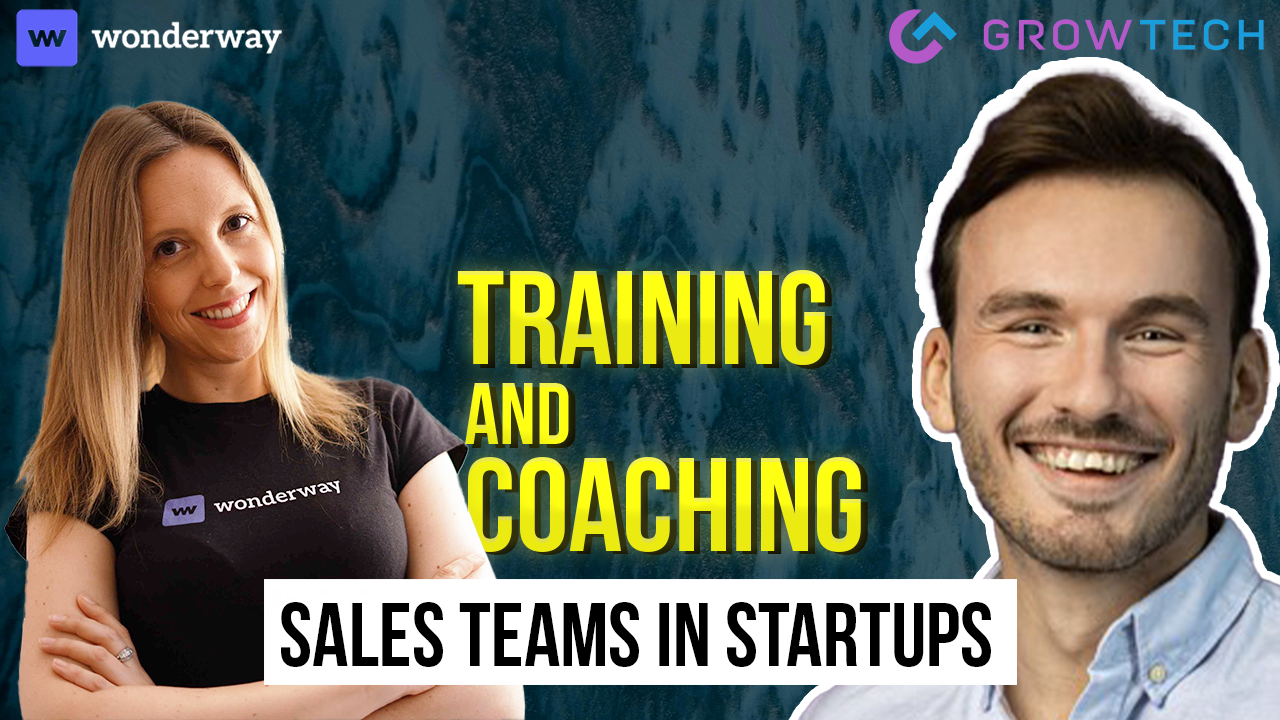
Mafalda Johannsen on training and coaching remote sales teams
If you work in startup sales, you have probably heard some version of this sentence:
“For remote work to work you need to adapt the way you work as well. It is not just like oh let us work from home and we are all going to be productive because we are happy.”
That is Mafalda Johannsen, Director of Growth at Wonderway, speaking on the Startup Sales Talks podcast by GrowTech. Wonderway is a revenue training and coaching platform for sales teams, and Mafalda lives exactly what she sells every day.
This episode is basically a masterclass on three things:
- how to make remote work actually work
- how to onboard and coach sales teams in a way that sticks
- how to use networking to grow your career and your pipeline
Let us walk through the key ideas, with Mafalda’s own words as the anchor.
Remote work is not “office work from the sofa”
Mafalda is a huge fan of remote work, but she is very clear about one thing
remote work only works when you change the way you work.
“For remote work to work you need to adapt the way you work as well. It is not just like oh let us work from home and we are all going to be productive because we are happy.”
So what does “adapt” look like in practice at Wonderway
Use your calendar as your control panel
In an office you can just glance across the room or tap a shoulder. Remote removes that social radar. Mafalda solves it with aggressive calendar hygiene.
“In a remote work environment you need the calendar. I need to look at the calendar and know when I can book a meeting with someone.”
Her rules for teams
- everything lives in the calendar
- colleagues should see what you are doing and when you are free
- time blocking is not optional, it is how the team respects each other
Over communicate on purpose
When you remove hallway chats you must create them.
Mafalda sets up regular informal catch ups where the rule is simple
no pipeline talk.
“We have times where we just talk about things that are not work. You need to keep that chitchat or people will feel isolated.”
At the same time, she pushes people to lean into written communication
- quick pings on Slack instead of assumptions
- clear context when you ask for help
- written decisions so no one is lost in the scroll
Remote does not mean you never meet
Wonderway is fully remote but not faceless. They invest in in person offsites and city meetups.
“Just because it is remote it does not mean you never see your team face to face.”
Examples she shares
- team offsites for skiing in Bulgaria and kayaking in Portugal
- monthly food and drink budget for colleagues who live in the same city
Remote gives flexibility and focus. The in person moments create trust and emotional glue.
Remote onboarding that actually creates performance
One big theme in the episode
most onboarding is bad. Not because of remote, but because it is built around the wrong things.
“The best onboarding I have ever had was in a company that was fully remote. All my previous on site onboardings were really poor.”
Wonderway solves this in two layers
their product and their approach.
Train only what people will use
Mafalda is ruthless about relevance.
“Onboarding should already show you the red flags. If I see the email is not great, I know this person will not be performing any time soon.”
Instead of three hour slide shows on the product and random policies, she designs onboarding around the daily tasks of the role.
For a new SDR, by week two she wants to see
- understanding of industry and personas
- ability to research companies
- ability to write a real outbound email
The assessment is simple and practical
“If you teach them how to use the CRM, the assessment should be show me how you add a deal to the CRM. If you teach them email, the assessment should be write me an email.”
Quiz questions are kept for policies only. The rest is real work, in a safe environment.
Assess early so you can coach early
Here is the key difference in her approach
onboarding is not only about teaching, it is about diagnosing.
“On the second week of onboarding I can already say this SDR is not great at emailing. The other one should be better at researching. So I know where I need to tailor my onboarding.”
This lets managers
- spot skill gaps before reps hit the phones
- avoid nasty surprises after two or three months
- decide where to spend coaching time instead of guessing
Wonderway as a product supports this with a sales learning platform and an AI coach, but Mafalda is clear
the tools only work if the design of onboarding is intentional.
Coaching is not a tick box event
Most leaders agree sales coaching matters. Very few actually do it well.
Mafalda sees the same pattern over and over
companies say they care about coaching, buy a tool, launch a training session, and then let “real work” kill any consistency.
“You have to make sure that life does not get in the way of coaching.”
Her principles for a real coaching culture
Coaching must be intentional
“Do not make training a tick box. Ask why are we giving this training in the first place What are the results we are expecting from it”
Before any session she expects answers to three questions
- What specific behaviour do we want to change
- How will we see that change in the data or on calls
- How will managers reinforce it in one to ones
If the answers are fuzzy, the session is not ready.
Reps must feel training helps them earn
Sales reps live in a simple reality
time not selling feels like money left on the table.
“Half an hour of useless training is half an hour you did not prospect or speak to a customer. You are taking money away from your sales reps.”
So she designs sessions that clearly connect to outcomes reps care about
- better meetings
- higher reply rates
- smoother call flows
- higher win rates
When reps feel that link, they show up differently. Mafalda shares that in past roles she skipped internal sessions yet happily paid for outside courses
“It is not that I did not want to learn. I just thought that training was not useful to me.”
Now she tries to be on the other side of that equation and build training people would actually buy if they had to.
Aligning sales and customer success in small teams
At Wonderway, Mafalda leads business development, marketing and customer success. That gives her a front row seat to a classic conflict in every revenue org.
Sales wants to close. Success wants to retain.
Her answer
intense alignment and shared ownership.
Involve customer success before the deal closes
Instead of throwing accounts over the fence, she wants customer success in the room while the deal is still alive.
“The customer success manager should be involved before the deal is closed. The prospect already knows the person and there is no awkward surprise later.”
This helps
- keep promises realistic
- avoid surprise feature gaps during onboarding
- make the first handover feel like a continuation, not a reset
Use tools and process, not heroics
As companies grow, coordination by memory does not scale.
Mafalda highlights the value of customer success platforms that centralise implementation, milestones and notes so that information flows between SDRs, AEs and CS teams without drama.
“It is very important that the prospect feels they are speaking with the same company throughout the sales cycle.”
The goal is one consistent story from first email through renewal.
Networking as a sales superpower not just for extroverts
Mafalda is extremely active on LinkedIn, hosts two podcasts, and runs marketing for a jazz band called Plus D Scene. For her, networking is not only social, it is a compounding sales asset.
“Networking is around credibility and word of mouth and time to response.”
Why networking matters for sales people
She sees three main gains
- Credibility
- A profile with ten thousand relevant connections simply lands differently from one with a few hundred.
- Word of mouth
- When you help people, they remember and send others your way.
- “Even nowadays I have total strangers coming to me saying someone told them I help people get jobs.”
- Opportunity flow
- Jobs, partnerships, podcast invites, warm intros for deals
- all of them ride on the back of relationships.
How she actually networks
Mafalda keeps it practical
- posts consistently on LinkedIn with a mix of helpful sales content and light personal posts
- comments with substance on other people’s posts instead of posting and vanishing
- goes to live events and treats them as another channel for connection
- uses her podcasts
- “A Day in the Life of a Persona” and “Sales Training Dreadless Sin”
- as a way to learn from guests and deepen relationships
One lovely detail
during the pandemic she helped many friends from tourism transition into tech. That “helper” reputation still sends new contacts her way today.
“If you genuinely help people, word of mouth will take care of the rest.”
Final thought
build your own information engine
At the very start of the episode Mafalda makes a comparison that sticks.
“What makes a good AI tool compared to another is the amount of information. The more information an AI has, the better it is going to be. It is the same with a human in sales.”
Her life story backs this up
- commission only sales in the United States
- operations and tourism
- music and theatre
- tech startups in Germany and Belgium
- now growth leader at Wonderway
She has turned all of that into a single skill set
helping teams learn faster than the market changes.
If you want three simple takeaways from her story
- Treat remote work as a new way of working, not office life in your kitchen.
- Build onboarding and coaching around real tasks and real assessments, not slides and quizzes.
- Network with intent and generosity. The deals and jobs come later.
Or in her own words
“Our brain works in silos if we do not expand our knowledge. In sales you sell to different people and cultures, so the more you know, the better you become.”