Is cold emailing dead in 2025?
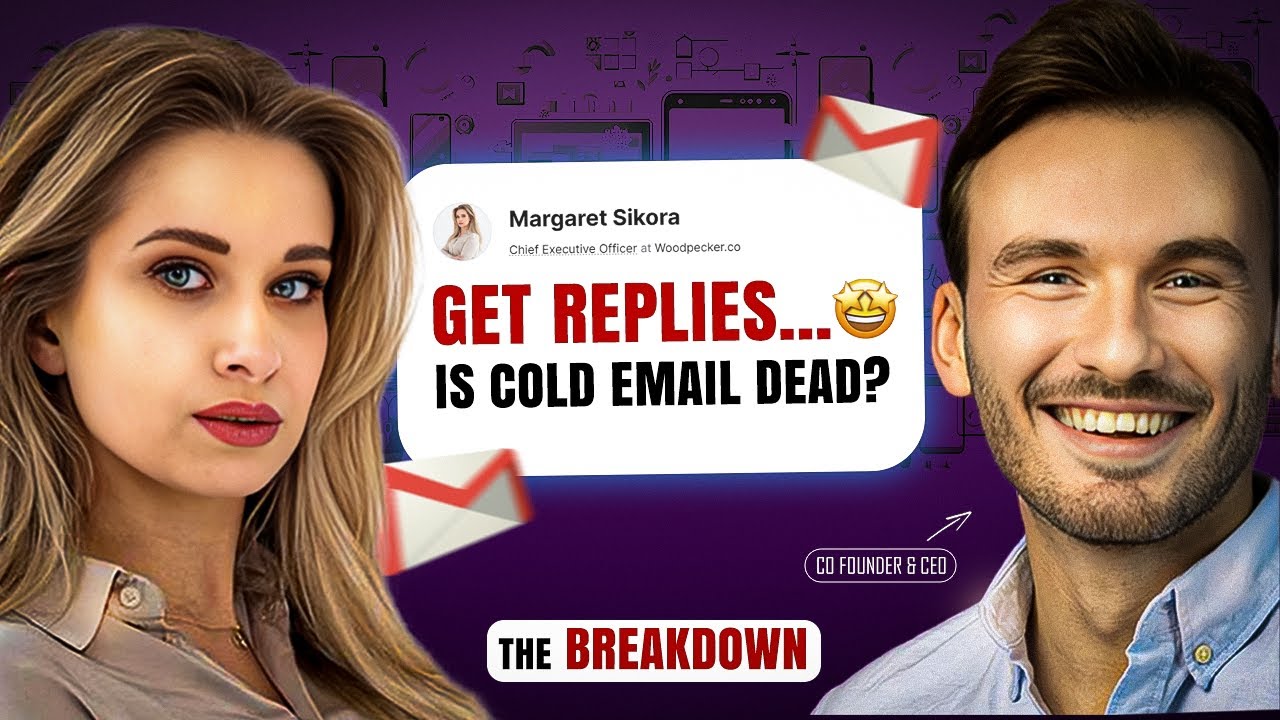
Cold email has survived every big trend so far. Automation. Deliverability updates. GDPR. And now the AI wave.
So when people keep saying in 2025 that cold email is dead, Margaret Sikora smiles. As CEO of Woodpecker, a nine year veteran platform in outbound automation, she sees the campaigns, the numbers and the agencies behind them every single day.
From her perspective, one thing is clear. Cold email is not dying. It is just finally demanding grown up execution.
From Junior Support to CEO of a Cold Email Veteran
Margaret did not enter tech through a typical route. By education she is a lawyer. She even finished a PhD in law as a side project. But what actually hooked her was not courtrooms. It was a tiny software company in Wroclaw with five people and a need for someone to support users.
She joined Woodpecker as a junior support agent. Over the years she moved through support leadership, customer success, product management, operations and finally, in mid 2024, into the CEO seat.
That long journey inside one company gives her a rare view. She has watched the evolution of outbound from the inside. From the years when any half decent campaign got replies to the present, where everything is stricter, more crowded and more technical.
Her conclusion is simple. Outbound is a game for stubborn people. The ones who do not quit when rules change.
What Woodpecker Actually Optimised For
Woodpecker has always been a cold email sequencer. It was first built as an internal tool to help another business send outbound in a more organised way. That business did not work out. The internal tool did.
Over nine years the product evolved around one core belief. Deliverability is the real battlefield.
Plenty of tools can send emails. Very few can consistently land them where it matters. In the primary tab, not in spam or promotions. That is where Margaret positions the company today. As the platform that guards sender reputation for agencies and outbound teams who send at serious scale.
She fully admits most people do not wake up excited about deliverability. She does. And after you have seen a perfectly designed campaign fail purely because of poor sender setup, it becomes hard to disagree with her priorities.
Is Cold Email Dead in 2025
On social media, the declarations are loud. Cold email is dead. Inboxes are saturated. Nobody replies.
Margaret answers that in two parts.
First, nothing in sales or marketing has become easier in the last five years. Paid ads are more expensive. Content marketing is more crowded. Every channel has raised its bar. So of course cold email feels harder too.
Second, she has a front row seat to tens of thousands of campaigns. She sees agencies and teams who still generate serious revenue from outbound, every month. For them, cold email is far from dead. It is simply more demanding.
If you strip away the drama and look at the economics, cold email still has one huge advantage. It is one of the cheapest ways to test a go to market hypothesis. With a few hundred euros you can buy data, warm up a domain, send several hundred targeted messages and see if anyone cares. Try doing the same experiment with paid ads on that kind of budget.
If your campaigns do not work today, she suggests a more honest diagnosis. The channel is not broken. Your approach is.
The 2 Metrics That Matter Most
Margaret ruthlessly simplifies the usual metric soup.
She highlights two numbers every outbound team should watch.
First, bounce rate. If it goes beyond a few percent and keeps creeping up, you are already in the danger zone. Ignoring it and hoping the next batch will be better is how sender reputations quietly die. The fix starts in your inbox. Read the bounce messages, look at what servers are actually telling you and adjust from there.
Second, the ratio of sent emails to positive replies. How many messages do you need to send to get one genuine interested response. Not a demo booked, not a closed deal yet. Just a clear positive reply.
That number tells you the real unit economics of your outbound. It shows whether your targeting, offer and copy are strong enough to build a pipeline or just burning time and domains.
Open rate still has its place, especially if you have a very small total market and limited volume to learn from. But she is blunt. Tracking opens comes with a deliverability cost because of the tracking pixel. That trade off has to be considered, not applied blindly.
How Many Emails Should You Send Per Prospect
Gone are the days when a ten touch sequence was considered bold but acceptable.
Margaret suggests a simpler starting point. One initial email with two or three follow ups. Three or four touches total. Enough to give the prospect a fair chance to see you without turning into the person who never leaves their inbox.
More advanced teams often recycle leads into another sequence after a month with a different angle or call to action. But that is iteration on top of a healthy baseline, not an excuse to spam the same person indefinitely.
Staying GDPR Safe Without Paralyzing Yourself
Because Woodpecker is based in the European Union, GDPR is not a theoretical topic. It is daily life.
Margaret frames it clearly. If you are using a personal email address, whether you found it on a website, LinkedIn or a directory, you are processing personal data. That means you must treat it as such.
There are three big practical points.
You must identify yourself and your company in your messaging so people know who is processing their data.
You must provide a clear and easy way for them to opt out, correct their data or ask you to remove it.
You must not hoard data forever. If someone never replied and you have not engaged them in years, delete the record instead of pretending it might magically convert one day.
Regulations differ slightly across countries, and some markets like Germany are stricter than others. But this basic hygiene applies everywhere and still leaves plenty of room for legitimate outbound.
How AI Is Changing Cold Email in Practice
At Woodpecker AI is not treated as a magic wand. It is treated as a tool for boring but important work.
They use it to detect interest levels in replies so campaigns can react automatically when someone says yes, no or maybe later. They use it to interpret out of office responses and reschedule follow ups for the right date. These are exactly the repetitive tasks language models are good at.
On the creative side, Margaret separates generic prompts from specialised tools. Asking a general model to write your sequence will usually give you something bland and forgettable. Tools like Twain and other sales focused assistants, especially ones trained on your own data, can offer much stronger support.
And what about the idea of a fully autonomous AI SDR that replaces humans. She is cautious.
If some company has built an AI SDR setup that truly works for their business today, she thinks they should absolutely use it. But she has not seen a general solution yet that can own the entire pipeline without human involvement, especially in complex B2B sales.
What she expects instead is a shift in the SDR profile. Less repetitive clicking. More work setting up and orchestrating systems. Less copy pasting. More thinking about targeting, offer and process.
The Future of Cold Email
Margaret does not believe in a romantic comeback where everything gets simpler again. The trend points in the opposite direction. More filters. More noise. More rules.
Her main prediction is that cold email will increasingly depend on brand presence and thought leadership. Teams that already show up on LinkedIn, on podcasts, at events and in other channels will see better outbound performance because prospects have seen their name before the first message lands.
Cold email will still be one of the most precise targeting tools in sales. You can still reach exactly the kind of company and role you want. But expecting a stranger to reply to a single message with zero previous context will feel less and less realistic.
At the same time, she expects more frequent surprises from the big mailbox providers. Google and Microsoft will keep adjusting their rules. Deliverability experts will keep chasing the new patterns. Nobody will ever have a perfectly stable environment.
The teams that survive will be the ones who treat this as part of the job, not as a one time configuration task.
How Margaret Learns Fast Enough To Keep Up
When you run a company in a space that changes every quarter, learning cannot be a side hobby.
Margaret’s approach is people first. She tries to surround herself with colleagues, customers and even competitors who genuinely know their craft. Tiny insights collected in daily conversations matter much more than a single grand theory from a book.
Her main warning is about advice overload. The more senior you become, the more opinions you hear. Most of them are noise. She suggests a simple filter. Do not take advice from people whose values, context or business reality are far from where you are or want to go.
The rest is repetition. She compares it to climbing. At the start you are convinced you will fall every second. After a hundred times, the same routes feel natural. Running a company is similar. The fear does not disappear in one moment. You simply get used to operating at that level of pressure.
Cold Email Is Not Dead. Lazy Cold Email Is.
If there is one message Margaret sends to founders and sales leaders, it is this.
Cold email still works. It still opens doors. It still scales cheaply compared to most other channels.
But the version that once worked with sloppy lists, templated copy and blind automation is gone.
What remains is a channel that rewards teams who respect deliverability, understand their market deeply and see email as one touch in a wider relationship, not their only move.